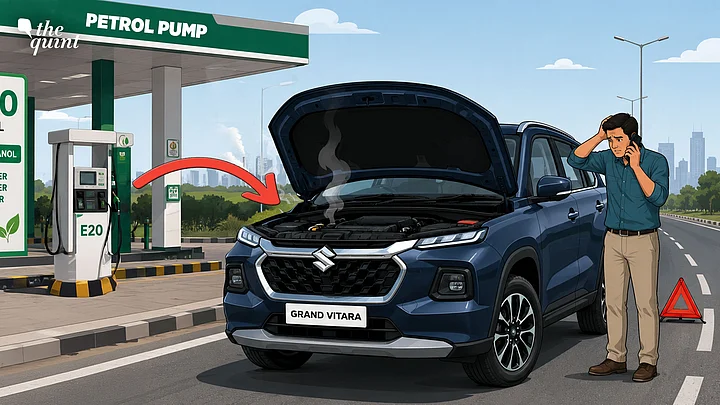
Even as the government doubles down on its E20 rollout, a landmark consumer court ruling in Chhattisgarh's Raipur ordering Maruti Suzuki to compensate a customer over engine issues linked to the E20 petrol could deal a significant blow to the policy.
Days before Road Transport and Highways Minister Nitin Gadkari asserted in Parliament on 30 July that no evidence of engine failures linked to the fuel had been found despite extensive testing, the District Consumer Disputes Redressal Commission in Raipur, on 14 July, directed Maruti Suzuki and its dealer to either replace a Grand Vitara Strong Hybrid that was apparently damaged by E20 fuel or pay the owner Rs 20.5 lakh within 45 days.
The owner, Dr Premraj Devta, a 41-year-old nephrologist, had bought the car in June 2024. He also took the extended warranty valid up to 2029 or one lakh kilometres, whichever came first.
But the car didn’t come close to lasting that long.
The Car Broke Down in Six Months
According to the documents submitted by the complainant, and accessed by The Quint, the engine warning light began appearing on the dashboard in November 2024, when the vehicle had clocked approximately 21,900 km. The company’s dealer claims the meter reading was 31,500 km.
The vehicle was taken to the dealer’s workshop, where ‘adulterated petrol’ was cited as the reason for the breakdown. The fuel tank was drained, cleaned, and new fuel added, and the car was declared fit.
Only after the car had been driven about 60 km more did the breakdown reappear, and the car was towed back to the service centre again. The tank was cleaned for the second time, and the vehicle was handed over to Dr Devta.
"Just two days later, the car broke down again. It continued to suffer at least six breakdowns and repairs until March 2025, after which the Grand Vitara has remained parked at the service centre ever since," Dr Devta told The Quint
According to an email produced before the court, Maruti informed Dr Devta that the issue was 'foam fuel adulteration' and that the engine and other components needed to be replaced. The company estimated the repair cost at Rs 5.3 lakh, which it said would have to be borne by the vehicle owner, despite the vehicle being under warranty.
"The car was around six months old in November 2024 when it first broke down. I had also taken the extended warranty for the car valid till 2029. So, why would I bear the cost of the repair which was estimated to be over Rs 5 lakh?," Dr Devta told The Quint
A company’s general manager reportedly offered to buy the car back at a 'depreciated' valuation of around Rs 12 lakh, but the doctor refused, insisting that he wanted a properly repaired engine, not a discounted buyback of a car he'd paid full price for.
Frustrated, Dr Devta reached out to the consumer forum and sought a full refund of what he'd paid, plus compensation for the disruption to his medical practice, totalling Rs 50 lakh.
Companies’ Defence
Both Maruti Suzuki and the dealer essentially maintained that there was no problem with the vehicle. The problem, they argued, was contaminated or substandard fuel that the customer had put into the tank, which they say was beyond their control, and that’s why they explicitly excluded it from the warranty coverage.
Maruti told the court that a white, jelly-like substance was found in the fuel. A fuel sample was then sent to SGS, an independent, government-recognised testing laboratory, for analysis.
The analysis found that the fuel tank contained E20 petrol, i.e. petrol blended with ethanol. However, the ethanol content measured only around 6-7 percent, well below the 20 percent that E20 fuel was supposed to contain.
The report suggested the discrepancy was likely caused by a white residue found in the fuel tank, which may have caused the ethanol to separate or diminish. As a result, the fuel, which was originally standard E20, may have degraded or stratified inside the tank.
Court’s Finding
After reviewing all the documents and the report submitted by both parties, the commission found that the fuel was not adulterated. It was the normal, government-mandated E20 petrol, which is now being sold across the country.
Apart from this, another startling revelation emerged during the court proceedings. Court documents revealed that the car Maruti sold to Dr Devta was already 17 months old at the time of sale. It was manufactured in January 2023 but sold to Dr Saika in June 2025. The documents also showed that the vehicle was not E20-compliant.
E20 cars were sold in India from 1 April 2023. Anything made before that cutoff simply wasn't engineered for it, running instead on lower blends like E0, E5, or E10.
The court concluded that Maruti sold Dr Devta a petrol car that was not compatible with E20 fuel, despite knowing that the Government of India had increased ethanol blending in petrol from 10 to 20 percent. The Commission held that this was never disclosed to the buyer at the time of sale.
This month, on 14 July, the Commission held the dealer and Maruti Suzuki guilty of deficiency in service and unfair trade practices. The companies have been directed to replace the SUV with a new vehicle of the same model that is compatible with E20 fuel within 45 days.
Failing that, they must refund the full Rs 20.5 lakh paid by the doctor, including the cost of the vehicle, insurance and registration. The Commission also awarded Rs 1 lakh as compensation for mental harassment and Rs 10,000 towards litigation costs.
If the companies fail to comply within the stipulated period, the amount will attract 7 percent annual interest from the date of the order until payment.
Maruti Suzuki To Challenge The Order
In a statement released to the press, Maruti said, “The car in this case was an E20-compatible car, fully equipped to handle E20 fuel and so disclosed in the owner’s manual. There is evidence of contamination in the fuel collected from the customer’s vehicle. Several other facts have not been reflected in the order.”
Maruti Suzuki will take necessary steps to challenge the impugned order before the appropriate higher forum in accordance with law,” read the statement.
On the issue of compatibility, speaking to The Quint, Dr Devta asked, “If the car is E-20 compliant and the fuel is also E20, then why did a brand new car break down so many times?”
Refuting the company's claim, the nephrologist questioned why the alleged fuel adulteration was not detected in the SGS laboratory analysis, to which Maruti had itself sent the fuel sample for testing.
“Even if we assume that the fuel was adulterated, the car broke down six times, and every time the tank was cleaned and fresh fuel was added. Still, the car continued to break down. What explanation do the companies have for this?” Dr Devta asked.
The Quint has reached out to Maruti Suzuki for comment on the allegations and concerns raised by the doctor. We will update this story as and when we receive its response.
Why This Case Matters Beyond One SUV
This case is not seen as an isolated case of vehicle damage and dispute between an Original Equipment Manufacturer (OEM) and a vehicle owner.
The government has been rolling out E20 petrol nationwide as part of its ethanol-blending programme, aimed at reducing oil imports and lowering emissions. However, experts say higher ethanol blends are not universally compatible with all engines.
Experts claim that older vehicles designed for E0, E5 or E10 fuel, or engines not optimised for E20, may experience issues such as fuel-line corrosion, seal degradation and combustion-related problems.
The ruling is significant because it raises broader questions about the compatibility of E20 fuel with older vehicles. It also lends weight to concerns that vehicle owners have been raising for more than a year about the impact of E20 petrol on vehicles not designed to run on the higher ethanol blend.
Nishant Verma, an advocate at Delhi High Court, says that while this judgement can be appealed in a higher court, the verdict can be seen as a milestone in the whole E20 crisis that has been brewing in the country.
"This is going to be a long legal battle, and people will follow the case quite closely because if the consumer, Dr Devta in this case, is able to get a judgement in his favour, then it will definitely pave the way for more people to come forward and claim damages for the vehicles they might have," said Verma.
Gadkari has challenged critics to show him even a single car that has been damaged by E20 fuel.
Verma says this could become the first such car in India, provided the finding is upheld by the higher courts, to be legally recognised as having been damaged by E20 fuel.
"At the very least, this judgment challenges the claim that E20 poses no issues whatsoever for older or non-E20-compliant vehicles," Verma said
Talking on the fuel and warranty situation in the case, Subhash Chandra Garg, former Finance & Economic Affairs Secretary to the Government of India, said, "Maruti is trying to take a line that they are not responsible if fuel is contaminated. They cannot speak against E20. As long as customers will be able to prove that they were using the only fuel being made available at the pumps, Maruti or, for that matter, any other manufacturer, will find it difficult to defend."
On being asked about the government's role in serving non-compatible fuel for millions of legally registered cars in India, Garg said, "It is absolutely unfair and high-handed on the part of the government to do so. It should make two additional fuel options available: ethanol-free petrol and E10 petrol. It may price these fuels within a range of up to 10 percent above or below E20, but all three fuel types should be made available to consumers."
While liability in Dr Devta's case appears to rest with the manufacturer because the vehicle was still under warranty, the situation may be very different for owners of older vehicles that are no longer covered by warranty. In such cases, fixing legal responsibility on manufacturers could prove far more difficult.
On this, Garg said, "The government should take responsibility and adopt proactive policy measures along the lines suggested above. Unfortunately, that has not been the approach so far. As we saw in the case of the NEET examination, corrective action often comes only after the problem has escalated. I fear the same could happen here unless the government acts before it is too late."