The first sign that 10 October would be no ordinary Saturday came the evening before.
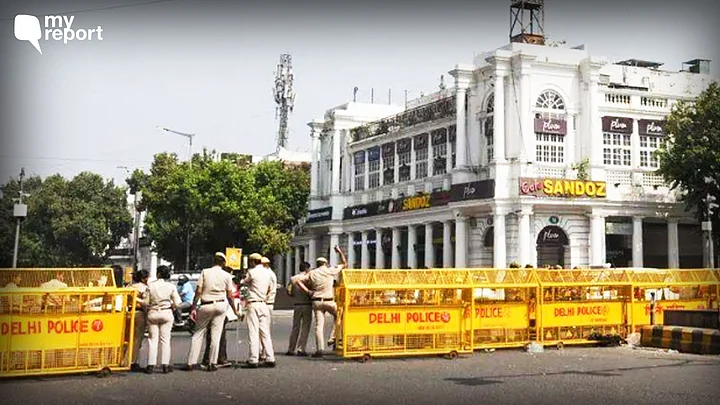
The Centre's response to a youth-led protest march, demanding the resignation of Chief Election Commissioner Gyanesh Kumar, was sweeping. From suspending several Delhi Metro operations and train services at New Delhi and Nizamuddin railway stations to imposing prohibitory orders under Section 163 of the BNSS in Central Delhi, India's national capital was effectively under a lockdown.
Incidentally, the Staff Selection Commission's Combined Graduate Level (SSC CGL) and Institute of Banking Personnel Selection (IBPS) Clerk exams were scheduled on the same day.
Now, these are no ordinary exams. Both are among the most sought-after government and public-sector recruitment exams for graduates. The SSC CGL can secure them a Central government post, and the IBPS Clerk exam is the gateway to clerical jobs at 11 public sector banks, with 11,403 vacancies this year.
Lakhs of candidates, mostly graduates and final-year students, compete for a few thousand seats, so a single mistake can cost a year of effort.
With the news of the restrictions on 10 October, my friend, Ariba Wasim, a 21-year-old BCom graduate who was appearing for the IBPS exam, kept refreshing the official website. However, there was no notification about the exam getting postponed or rescheduled.
She had prepared rigorously for months, and now a sense of uncertainty started to unsettle her.
'A Journey With No Margin For Errors'
Her centre in Mundka, West Delhi is around an hour or so from her home in Sector 62, Noida on a normal day.
The exam centres are often allotted in far-flung parts of Delhi-NCR, so many candidates already travel long distances. On Saturday, the curbs made things worse.
We left home at 11 am, two hours before the 1 pm reporting time. A few kilometres after we took the Delhi-Meerut Expressway, we ran into heavy police deployment and barricading near the border.
Every vehicle slowed to a crawl. Police personnel looked closely at passengers, stopping some at random and questioning them.
Before we left from her home, we were prepared to travel a total distance of 55 km till the centre in Mundka. But, with the main routes through New Delhi closed, we were pushed onto diversions through outer Delhi and ended up covering more than 75 km.
The final stretch led through a village area with narrow, congested roads that were clearly struggling with the number of vehicles. We arrived with a little time to spare, and both of us feeling hassled.
'It Has Never Happened Before'
My friend hurried inside. While I waited outside for her exam to finish, I spoke to a few other students and their family members.
One applicant from Inderlok told me that he took an auto to the nearest operational metro station because his own had been shut. “I do not understand what the need was to close these many metro stations. It has never happened before. Because of the closure, there were traffic jams everywhere,” he said.
A candidate from Sector 34, Noida said the news of transport curbs had made her panic. “I have been preparing for the exam for a year now,” she said. She feared she would have to miss it. She said she was relieved when she found out that Noida’s metro stations were open though she left home almost three hours before reporting time as a precaution.
A father who had come to drop his daughter said the government "should have thought about students" before taking such strict measures. It was "unfair", he said, to create chaos for students travelling from different parts of the states for an exam that could decide their future.
When we left, we took the flyover towards Rohini, passing Bhalswa. We crossed several police buses. My first thought was that they were carrying detained protesters to Bawana or Narela. Barricades lined the route, and policemen kept peering into car windows.
'Adding to the Stress'
Ariba shared with me that when the competition is already tough, with lakhs of candidates fighting for a limited number of seats, the last thing an aspirant needs is to spend their energy worrying about whether they will reach the exam centre on time and whether they will be allowed to take the exam. Feeling more anxious than she'd have usually felt, she added that she was able to focus only once she was inside the hall.
The next day, in a special hearing, the Supreme Court ordered the Delhi government to remove boards announcing Section 163 outside the court premises. The court also told the authorities to review all barricading across the city and remove any unnecessary ones, so that people and traffic could move freely.
It also ordered metro and rail services to run normally.
The protest and the policing will be debated for a long time. My thoughts stayed with my friend in the car beside me and in the queues outside the exam centre: students who had done everything right and then had to cross a city on edge just to sit a two-hour test.
The State said it was preventing disorder. For the people caught in the middle, it simply made an already high-stakes day harder.
Delhi Police Traffic Advisory On 9 October
On 9 October, Delhi Police had issued a traffic advisory ahead of the planned protest at Jantar Mantar on 10 October, warning of possible traffic restrictions and diversions at 30 locations across the national capital. The restrictions were expected to begin at 6 am, depending on the law-and-order situation.
The advisory mentioned key areas, including Connaught Place, Mandi House, Dhaula Kuan, and Jhandewalan, and advised commuters to plan their journeys in advance, allow extra travel time, and avoid non-essential travel through the affected areas.
(The Quint has reached out to Delhi Police on the issues raised by the candidates in this My Report. Their response is awaited. The story will be updated as and when they respond.)
(The author is a journalism student at Jamia Millia Islamia, New Delhi.)
(All 'My Report' branded stories are submitted by citizen journalists to The Quint. Though The Quint inquires into the claims/allegations from all parties before publishing, the report and the views expressed above are the citizen journalist's own. The Quint neither endorses nor is responsible for the same.)