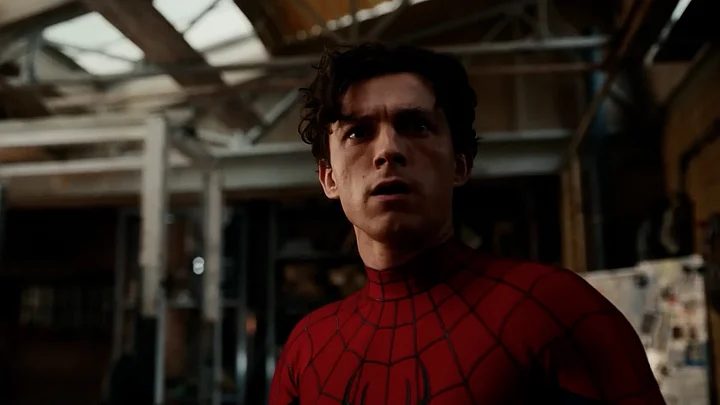
Once the nostalgia of watching a new Spider-Man movie after nearly five years wears off, a worrying thought emerges: Is Spider-Man: Brand New Day really just Spider-Man: All Over Again in disguise? Is Destin Daniel Cretton’s film just a factory reset of the New York-based comic-book superhero tale, but with the same actor? Does anything ever truly end in the Marvel Cinematic Universe (MCU)? Will my trust issues ever subside? Every new MCU cycle feels like a post-concert encore of the previous one.
The framework is not foolproof.
Dr Strange’s spell in the admittedly sweet Spider-Man: No Way Home (2021) means that the world no longer remembers Spidey’s secret identity, Peter Parker. Young Peter hoped the spell could be customised, but nobody had the memory-wiping machine from Eternal Sunshine of the Spotless Mind.
In superhero parlance, it’s the price Peter (an eternally boyish Tom Holland) is willing to pay to protect his loved ones: namely ex-girlfriend MJ (Zendaya) and best friend Ned (Jacob Batalon). So he is essentially back to being a street-crime-fighting mutant vigilante worshipped by everyone—including the cops.
New Yorkers blissfully go about their matcha-sipping lives while their city gets battered every few days; they’re so desensitised to violence and large-scale property damage that you wonder if Spidey is saving anyone at all.
A Full-Time Superhero
The conflict of Brand New Day is interesting. Given that he has no life outside of his mask, Peter Parker has no choice but to commit to his identity as a full-time superhero.
He craves for more jobs. He becomes a workaholic to distract himself from normal emotions: like missing MJ and Ned, wishing he could be with them in MIT, and yearning for a life as a happy-go-lucky student who should’ve been bitten by a mosquito instead. But he’s too young to be reclusive.
This takes a psychological toll, and suddenly, Peter finds himself struggling to deal with the hormonal changes that mark the transition from adolescence to adulthood. His crippling identity crisis raises the question: What if Imtiaz Ali made Spider-Man?
Jokes aside, the story explores the consequences of the lonely-superhero trope through the lens of urban isolation. It questions the traditional narratives of sacrifice, selflessness, and anonymity for a generation that’s just not wired to do things alone.
Holland has this distinctly soulful look on his face when he sees his mutuals carrying on as if he never existed. There’s a stillness in these moments, especially his exchanges as a ‘stranger’ with MJ, where his eyes are almost willing her to remember him. It’s a bit like 50 First Dates as a Marvel production.
Perhaps this pathos is what the film should have trusted—a coming-of-age drama about a 20-something demigod in need of therapy, battling to debunk the myth of the old-school martyr. He even invents an inhibitor to regulate his changes (or his “mood swings”), lest he enters the realms of bipolar disorder.
Scale Up and Dumb Down!
But as with most MCU movies, there’s the fan-service pressure to scale up, dumb down and load an intimate journey with generic spectacle. Every time the film threatens to get real about Peter’s burden, the ‘main’ storyline gatecrashes the passage, like an insecure boss that pops up at their employee’s desk the second they look out the window. Earlier it’d be a quip by Iron Man that would diffuse any narrative tension; now it’s the plot itself that keeps reminding Spider-Man that he’s in an expensive movie and there’s no time to cry.
It’s been more than two decades, yet so many modern superhero movies (barring Thunderbolts) still unfold like the cinematic equivalent of Indian boomers: afraid of feelings, using the crutch of urgency and humour to deflect.
I suppose this ties into the central tussle between Peter’s two personas—who he is versus what history needs him to be—but it’s frustrating to see how often a poignant scene is interrupted by big-picture motion. Every emotion feels incomplete.
The film remains too much in service of its stature in the broader MCU organisation; you can almost hear the corporate overlords yelling “don’t think for yourself, remember your place as a salaried minion”. Out come the branded deals and events.
The clunky storyline featuring a villain who reflects Peter’s seclusion hijacks his arc to make the same point, but with overcooked action set-pieces that try to justify the beginning of a trilogy in the AI era. The (telepathic) nature of the antagonist is also responsible for the film’s clumsy visual character.
When the Film Keeps Things Small
There’s a parody-like tone to the co-existence of the city’s residents and the other-wordly carnage on its streets. Everyone accepts Spider-Man and his ilk so casually that the fading wonder of a superhero itself becomes the franchise’s punchline. It’s done to death by now, and Brand New Day looks too tired to deal with it.
The film works best when things are small, serious and contained. The sibling-like banter between Jon Bernthal’s nihilistic Frank and an irritated Spider-Man is one of these tracks; their bond alone could’ve delivered the message about the curse of heroism and unchecked mental-health problems.
There’s a nice sequence towards the end, where Peter Parker sees the adulation for Spider-Man and expresses the joy of a famous athlete who has rediscovered his grassroots love for the game.
For a fleeting minute, it feels like the film has finally understood its own essence—an adult who chooses mortality to avoid the grief of living too long; a boy who chooses to stay connected to the people he is obligated to protect. But then the end credits roll, and nobody moves.
The lights stay off. Everyone waits for the signature Marvel post-credits scene (a total anticlimax in this case); the franchise takes over again. And the transition from Spider-Man: All Over Again to Spider-Man: Nowhere Left To Go is complete.
(Rahul Desai is a Mumbai-based film critic. His reviews and columns have been published in Mumbai Mirror, Film Companion, The Hindu, Firstpost, Ottplay, News9 and others. He currently writes for The Hollywood Reporter India.)