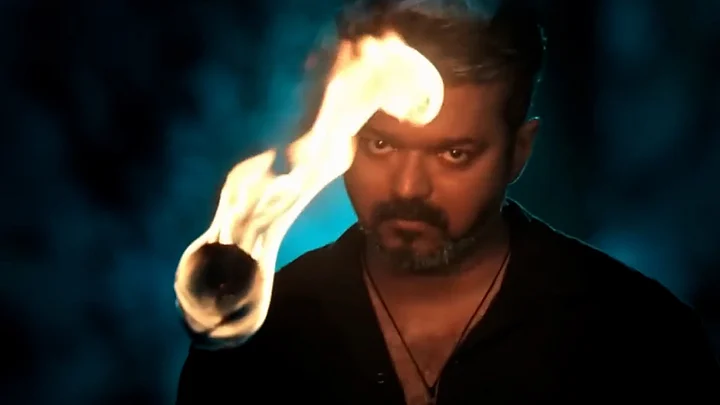
Coming after nearly a six-month hiatus following its originally scheduled Pongal release in January this year, the superstar Vijay then, and the present Tamil Nadu Chief Minister C Joseph Vijay now, carries Jana Nayagan to his final box-office finish line as only he can.
That it will be a blockbuster at the box office may be a foregone conclusion, given the mind-boggling advances it has collected despite its pirated version being leaked earlier. Made on a humongous budget of around Rs 400 crore, the film needs to bring in steady collections over the weekdays and the following weekends to break even and become a bona fide success.
Given the whopping box-office business in India and overseas of the star's past releases—Master, Leo, and The Greatest of All Time (GOAT)—this task for Jana Nayagan is an easy walk in the park.
From Superstar to Chief Minister
It was during the peak years of Rajinikanth in the nineties, as the star icon belted out one commercial success after another, that Vijay broke onto the scene with Poove Unakkaga (1996), a film that hit the box-office bullseye and firmly settled him into the hearts of discerning Tamil cinegoers.
Since then, for over three decades, Vijay has etched himself into the collective consciousness of Tamil movie lovers with his performances, mostly in over-the-top commercial cinema that guaranteed the much-needed footfalls as well as his signature whistle-podu moments for audiences and producers alike.
If Kamal Haasan and Mani Ratnam scorched the screens with their 1987 classic Nayakan (Hero/Leader), a take on the Bombay underworld swathed in the silky silhouette of Coppola's The Godfather, then director H Vinoth and Vijay have taken the Nayakan template to represent the common citizen's groundswell and turned it into Jana Nayagan—The People's Leader—mirroring the protagonist's core allegiance to everything for the people and by the people.
Vijay's latest and, for the record, last marquee outing is worth it, especially for the occasion that the film lends itself to—a megastar in his own right riding successfully on his fans' and the people's mandate in the state, becoming its Chief Minister just over a couple of months ago. This alone will undoubtedly push scores into cinema halls in anticipation.
But crucially, does the film carry itself through all this excess baggage and these gargantuan expectations, or will it just be an overdone, screeching fan service to one of Tamil Nadu's last superstars? The answer is yes, it does.
A Farewell Worth the Hype?
Even with its weak portions, especially in the second half, the performances by the leads and some banging riffs from music director Anirudh help paper over some of the film's brittle moments.
Vijay packs his fists full of anger and retribution with elan; his feet and torso sway with unrestrained panache to every dance move and beat that the choreographer and music director lob at him. Bobby Deol, to his credit, pulls off the unthinkable.
The portions where his backstory gets space in the second half prop up his role well, especially given that the makers give him considerable screen time rather than treating him as just another popular Bollywood name thrown in for eye-candy moments.
Overall, Jana Nayagan does its job. It takes the viewer on a ride that is enjoyable and satisfying. Where it falters, Anirudh's interludes—especially Raavana Mavaanda playing in the background—lift it to a completely different level. The performances stay with you.
Vijay and Mamitha spark a commendable chemistry, but the surprise package is Raichal Rabecca Philip as Porkodi, delivering a searing performance that elevates the second half.
Fan Service Over Finesse
No one steps into a Vijay movie expecting to see a virtuoso Mani Ratnam cut or the aching pathos of an Arvind Swamy performance set to AR Rahman's melancholic music. What they expect from their Thalapathy, they already know—and that is exactly what the director and his team dish out. There are sections in the narrative that deliver a serious top-drawer dopamine rush to Vijay's fans, and it is here that Jana Nayagan packs its punch.
The main problem with the film is that it tries to crowd too much in, and by the time the first half is done and dusted, the viewer has to grapple with so much that it becomes virtually fatiguing.
There is a lot that Vinoth's film borrows, both in terms of contemporary socio-political references and the tried-and-tested formula that has long been the staple of Tamil and Telugu cinema. By now, it is no secret that it is an acknowledged remake of the Telugu film Bhagavanth Kesari(2023), but it also scrapes a lot from Atlee's Shah Rukh Khan-starrer Jawan, mainly in how the action and set pieces are staged whenever the hero slips into action-Marvel mode.
Too Many Plotlines, Too Little Focus
The film begins with Vijay in jail, trying to school all the rogue inmates while protecting the elderly and the weak. Even the police revel in his protection, and he becomes everyone's saviour. Some cheeky orchestration accompanies the free-for-all that ensues, with the lines, "I got a gang. We run the space, bang bang," set to a thumping beat.
It is at this very early point in the film that true-blue Vijay fans know they have to settle into their seats, while those looking for any kind of film-festival fare over the next couple of hours should probably leave the building. This is akin to a warning—without the constitutional s-word.
As the protagonist's friendship blossoms with a police officer's child, Vijay (Thalapathy Vetri Kondan) takes on the role of her father, mother and guardian angel. This is the key strand that carries the film forward, with other story elements woven around the relationship he develops with Mamitha Baiju (Viji), the popular Malayalam actor who holds her own very well.
Mamitha overshadows Pooja Hegde, who is paired opposite the hero but whose role feels more like an afterthought.
If issues of domestic politics, corruption, and atrocities against the vulnerable and marginalised are not enough fodder, the film takes on the much-in-vogue cross-border terrorism trope and stretches it all the way to Africa, to a make-believe Republic of Swasnia that proudly displays Nelson Mandela on its ghetto-like prison walls for geographical reference... whatever.
Here, Lord Bobby Deol, as Immortal John Himmler, has nefarious plans under the acronym MM to destroy India. But with Vijay around, he first has to get through Tamil Nadu.
The plot is nothing much to speak of, with subplots being added as and when the director chooses. Gender justice and women's agency are themes the film attempts to tackle in the second half, but most of these efforts are sporadic and only scratch the surface. Again, after some neat post-interval moments—particularly Deol's backstory—and Vijay's histrionics in 2005 Madurai during his time in the police force, the film vacillates, unsure of which plotline to hold on to.
A Fitting Political Send-Off
Vijay, Mamitha Baiju, and Bobby Deol are well supported by familiar faces including Revathi, Priyamani, Narain, and Nassar.
Prakash Raj also does well in a tailor-made role. Apart from the sloppy screenplay, what lets the film down in a big way is the abominable manner in which VFX is employed, with rogue drones and robotic humanoids going haywire in a confrontational stretch that boggles the mind, given the huge budget the film was made on.
As the end credits begin to roll and Vijay fans are treated to an array of famous clips from his old films, one can see why the film was held back by the powers that be.
While Shah Rukh implored citizens to realise the importance of their votes in elections in Jawan, here Vijay takes a step further, urging us to "see", "understand", and "introspect" before deciding to whom we cast our precious votes. For if we fail this critical test, then the blame for voting an incapable, dishonest, and self-serving lot into power rests wholly on us.
Everything else aside, for this message alone, Vijay and Jana Nayagan are winners.
Jana Nayagan releases in theatres on 23 July.
(Anand Mathew is based in New Delhi and writes of films, entertainment and contemporary issues.)